
Stages of Coffee Roasting: How They Affect Your Coffee’s Flavor
Since 1995, the SCAA Coffee Taster’s Aroma Wheel has been the industry standard for coffee professionals worldwide in the coffee roasting process.
The explanatory coffee wheel, developed in collaboration with the SCAA and World Coffee Research, features a comprehensive list of descriptive terms that reflect the specialty coffee standards of the time.
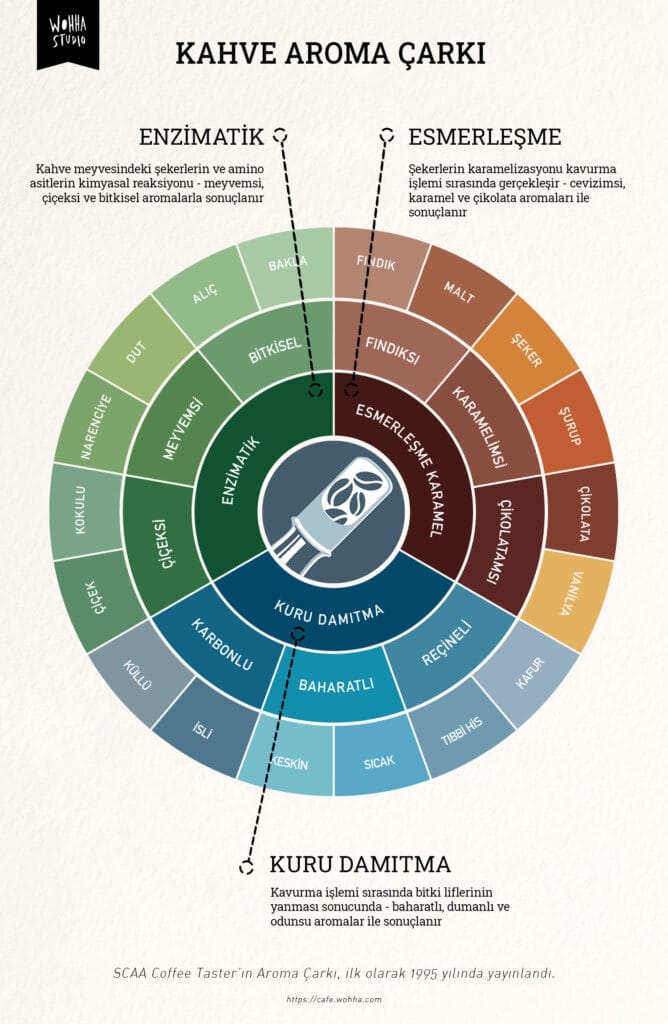
Turpeny: An aromatic sensation created by a group of lightly volatile hydrocarbon compounds and nitrites that produce resinous notes reminiscent of turpentine or medicinal notes reminiscent of camphor in the aftertaste of coffee.
How Is Coffee Roasted?
The transformation of green coffee beans into roasted beans is a miraculous process for coffee lovers. Despite the centuries-long evolution and industrialization of the coffee roasting process, in countries that produce green beans, roasting is still carried out in pots or over an open flame just as it was in the early days—which actually means we can even roast coffee at home. In this article, we’ll try to explain industrial roasting methods and the different types of roasts.

There are two different coffee roasting methods. The first uses drum roasters, and the second is the air-roasting method. With drum roasters, heat first warms the drum, then transfers from the metal to the coffee through contact, roasting the beans. In air roasting, however, heated air continuously circulates through the coffee, mixing and heating it. With this method, the coffee beans are roasted by absorbing heat directly from the air. Roasting with air allows for more uniform and easier roasting of coffee beans, because with drum roasters, you must constantly stir the beans and monitor them to ensure even heating through surface contact. Furthermore, while air roasting takes 7–8 minutes, the process in drum roasters exceeds 22 minutes.
What Happens During the Roasting Process
The longer coffee beans are exposed to heat, the more they lose their aroma and begin to develop a bland taste. Therefore, to fully bring out the aroma, it is necessary to determine the optimal roasting time for each bean and capture the coffee’s true flavor without losing its aroma. Industrial roasting is carried out with the careful monitoring and control of mathematical, chemical, and physical parameters. Depending entirely on the roaster’s preference, the roasting process is completed in 10–25 minutes at a temperature of 180–250°C.

Humidity
As a result of the coffee roasting process, most of the moisture in the green coffee beans evaporates.
Volumetric Change
Under the influence of heat, the oils and sugars inside the coffee bean are released. As a result, the drying bean expands in volume and surface area, which enhances the interaction between the water and the coffee during brewing.
Density
The water inside the green coffee bean accounts for approximately 12–25% of the bean’s weight, meaning that once the roasting process is complete, the weight of the coffee beans decreases by 12–25%.
Color
The green kernels turn yellow within the first few minutes. Then, under the influence of heat and time, they gradually turn light brown, brown, and finally black.
Oils
As coffee beans are roasted, the oil inside tends to rise to the surface. We can say that beans with oil visible on the surface have been roasted too much.

Light Roast
This roast is performed at temperatures between 180–205°C. The roasting process is stopped just before the first crack is heard as the coffee bean expands due to moisture loss. If the beans being roasted have fruity and floral aromas, this roasting method allows you to capture all their rich flavors. As you continue roasting the coffee and increase the temperature, the rich flavors will become less pronounced and give way to bitter notes.
Medium Roast
This is the most popular roasting method, performed at temperatures between 210–220°C. It is stopped before the second crack. Beans roasted using this method develop a balance of aroma, acidity, and flavor.
Dark Roast
This roast is performed at temperatures ranging from 240–250°C. A dark roast is ideal for those who want to experience bitter flavors and feel the coffee oils on their palate. It is also frequently used in espresso blends, as espresso beans are expected to be oily. Additionally, Robusta beans are used alongside Arabica beans in espresso blends. The reason for this is that a more efficient crema can be achieved with Robusta beans. A dark roast is used to bring the flavors of the Arabica and Robusta beans in the espresso blend closer together. If the two bean types are roasted less intensely together, their flavors will be very different from one another.

Tasting the Flavors of Your Coffee
However, over the past twenty years, climate change has forced coffee producers to cultivate varieties that are increasingly resistant to drought and disease, and has prompted sensory experts to adopt a more descriptive approach to defining coffee flavor. The Aroma Wheel received its first update in 2016, drawing on research compiled by dozens of sensory scientists at the Sensory Analysis Centre. Today, it is part of the most comprehensive research on coffee flavor.
When drinking coffee, its aroma, acidity, body, and aftertaste after the first sip help you describe the coffee. We actually perceive many foods through smell rather than just the tongue and palate. Through the interaction of the tongue, palate, and nose, all your senses are stimulated, enhancing the enjoyment you derive from the coffee.
The updated coffee wheel aims to go beyond the cup for coffee roasters and baristas. It also serves as a valuable tool for everyday coffee drinkers who want to distinguish good coffee from bad. Abridged versions, such as the Coffee Aroma Wheel and Taste Wheel, have been created. You can use these to improve your sense of taste and to perceive and describe coffee.
Exploring the Flavor Wheel and Aroma Wheel
The taste of coffee is a combination of chemical compounds detected by taste buds and aromas detected by the nose. In addition to sweet, salty, bitter, and sour taste characteristics, coffee aroma is one of the most important aspects of the coffee tasting experience. Both the aroma and the flavor profile play a crucial role in understanding and describing coffee. The key is to observe them at different stages.
Aromas enhance the sensory experience of coffee, and our sense of smell significantly influences our sense of taste. To fully appreciate the aroma of your coffee, we recommend purchasing small quantities of freshly roasted coffee on a regular basis and grinding your beans just before brewing.
Coffee Roasting Stages: Our Recommendations
How Do You Read a Coffee Ground Reading?
Step 1: Take a Whiff of Coffee
Pay attention to the aromas of freshly ground beans, as they reveal a lot about the coffee’s freshness and character. Then, brew a fresh cup of coffee and take a moment to smell the aroma as it brews. Learn how to ensure your beans are always fresh when it’s time to brew.
Step 2: Get to Know the Aroma and Flavor Wheel
You might come across some words you don’t know, but don’t worry about that at this stage. For now, just go with the flow.
Step 3: Start from the Center
Start at the center of the Aroma Wheel and work your way outward from the general descriptors. As you move toward the edge of the wheel, you’ll notice that the descriptors become more specific.
Step 4: Taste Your Coffee
Now take a sip of coffee and think about the flavors you taste. This time, return to the Flavor Wheel and start from the center again. Just like on the Aroma Wheel, the flavor descriptors become more distinct as you move outward.
5. For example:
A coffee connoisseur can detect hints of strawberry. As you move through the “sweet” section, you’re faced with a choice: “acidic” or “mellow”? If you decide on “mellow,” refine your observations further—is it “light” or “delicate”?
6. A Trio of Scents
There is a common misconception that the tongue is responsible for detecting complex flavors; in fact, this is the nose’s job. Aroma can be perceived in two ways: nasally (smelling the coffee) or retro-nasally (when coffee is consumed and the volatile aromatic compounds are carried upward into the nasal passage).
It is said that coffee contains over 800 aromatic compounds. Recent studies have classified these into three broad categories.
7. Enzymatic Flavors
The most pleasant, enzymatic aromas are byproducts of active chemical reactions that occur when the pH level of the coffee cherry ranges between 5.0 and 7.0. They bring out the coffee’s “fruity,” “floral,” and “herbal” characteristics.
8. Browning Aromas of Sugar
This aroma category is most sought after by roasters for the characteristics it imparts to coffee, such as chocolate, caramel, and nutty notes. As the name suggests, aromatic compounds are released in two stages: the Maillard reaction and caramelization.
9. 150–200°C
At temperatures between 150 and 200°C, carbonyl groups (from sugars) and amino groups react to release hundreds of aroma and flavor compounds in a process known as the Maillard reaction (browning).
10. 170–200°C
Between 170 and 200°C, the sugars in the coffee begin to caramelize (turn brown), and deeper flavors develop. Most of the sugars are converted into caramelized compounds through this caramelization process.
Learn About the Flavor Profiles and Aromas of Coffee Beans
Sourness – Acidity
A sour taste should not be viewed as either a positive or negative trait. In the coffee world, it is sometimes perceived as a desirable characteristic of high-quality coffee.
The mild or sharp tingling sensation you sometimes feel on the edges of your tongue is caused by acidic compounds formed due to insufficient extraction during the brewing process. This results in a sour and generally weak taste.
If your brew is more sour than usual, the reasons why and how to prevent it are explained below.
Bitterness
On the other hand, coffee that has been over-extracted tends to taste bitter. Factors that could explain this bitter taste include over-brewing or using a coarse grind.
It’s worth noting that bitterness is a universal characteristic of beverages and is therefore essential to the flavor of coffee. At low levels, bitterness can mellow the coffee’s acidity and add an interesting dimension to the brew.
However, too much bitterness can overpower the other components in the coffee, resulting in an unappealing taste.
Sweetness – Fruity
The sweetness of coffee is closely related to the ripeness of the coffee cherries, which contain natural sugars when harvested. Sweetness is generally a good indicator of how well the coffee has been cared for at every stage, from washing to drying and from roasting to storage.
The term “sweet” is also used by professionals to describe the intensity of sweet notes in a particular coffee.
Bitterness is considered a flavor defect by coffee experts. This unpleasant quality is generally undesirable and indicates the presence of residual inorganic substances or contaminated mineral content in the coffee.
In addition to sour, bitter, sweet, and salty flavors, there are other flavor dimensions you won’t find on this wheel.
For example, the body of a coffee—or the sensation it creates in the mouth—is the viscosity and texture caused by undissolved protein molecules and fats that remain in your brew, located near the back of the tongue. It can range from light and delicate to heavy or full-bodied.
A full-bodied coffee has a rich, lingering flavor that stays on the palate for a long time, whereas a light-bodied coffee is thin and watery and fades from the palate more quickly after drinking. Colombian and Sumatran coffee beans are well-known examples of full-bodied coffees.


Coffee Tasting Is an Art
You’ll find that many flavor profiles tend to overlap. Just as appreciating wine does, developing a distinct palate for coffee requires practice. You need to “train” your taste buds and nose with some exercises so they can learn to distinguish between different flavors and aromas.
By putting in a little effort every day, you’ll be able to appreciate your fresh brew even more.