What Are Basic Sauces and Their Varieties? How Are Sauces Prepared?
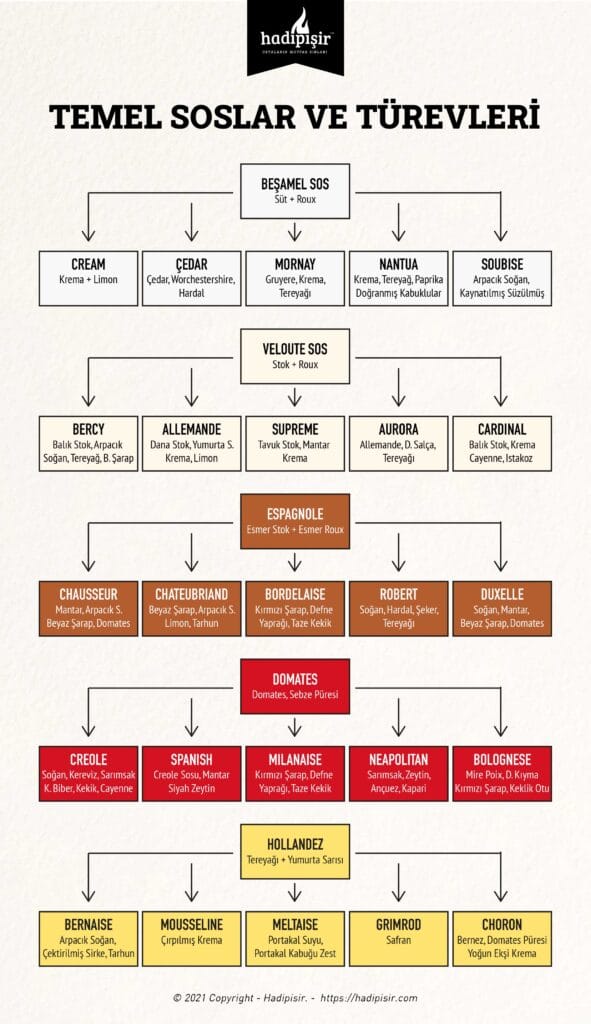
Before we move on to the guide on basic sauces and their variations, let’s start with a brief overview: there are five basic sauces used in French cuisine. Other variations are sauces that are created by adding different ingredients and flavors to the base sauce once it has been prepared.
What Are Basic Sauces and How to Make Variations:
The 5 Basic French Sauces:
- Béchamel Sauce: (made with butter, flour, and milk) Béchamel is typically the base for more complex sauces such as white sauce, morning sauce, and soubise sauce. Béchamel can also be added to dishes like gratin, pork medallions, and even mac and cheese.
- Velouté Sauce (Velouté): (made with roux and lean meat) Velouté is used in Chicken Wellington, various pasta dishes, and other chicken dishes.
- Espagnole Sauce: (made from veal stock, brown stock, mirepoix, and tomatoes) Espagnole sauce can be used in beef dishes, chicken dishes, and mushroom dishes.
- Tomato Sauce: (short for “tomato sauce” and can contain a wide variety of ingredients) Tomato sauce can be used in just about anything: spaghetti, lasagna, cavatelli, chicken parmesan, casseroles, soups, pizza—you name it!
- Hollandaise Sauce: (made with butter, poached egg yolks, and lemon juice) Hollandaise is commonly found in dishes such as Eggs Benedict, poached salmon, and poutine. It is also a classic pairing with asparagus.
Preparation of Béchamel-Based Sauces:

Cream Sauce (A Variation of Béchamel Sauce):
Beurre blanc, also known as a cream sauce, is a classic French sauce traditionally made with béchamel, cream, and lemon; however, to enhance the flavor, it often includes shallots, vinegar or white wine, and lemon juice. You can serve this silky sauce over fish or chicken. To prepare it, start by making a classic béchamel by combining butter, flour, and milk to create a roux. Then, add lemon juice, zest, and cream to finish the sauce.
Ingredients for the Cream Sauce:
- 3 tablespoons of unsalted butter
- 2 tablespoons all-purpose flour
- 1 cup of milk
- 1 ¾ cups of cream
- 1 clove of garlic, grated with a Microplane
- ⅓ cup freshly grated Parmesan cheese (optional)
- 1 tablespoon chopped fresh parsley
- salt and freshly ground black pepper
What Dishes Can Cream Sauce Be Used In?
It can be served as a base for pasta or many other dishes. You can use this sauce with almost any type of pasta. Any pasta with a surface that holds sauce is suitable for a cream sauce. In particular, the wide and thick shape of fettuccine allows you to get the maximum amount of sauce with every bite.
Last but not least: You can also use this sauce with your favorite cooked vegetables and proteins, such as grilled chicken or shrimp. Additionally, this cream sauce can serve as a base for other dishes, such as baked pasta and lasagna.

Cheddar Sauce (A Variation of Béchamel Sauce):
Before making the cheddar sauce, you first prepare a roux using butter, flour, and milk, then add cheese to it to make the sauce.
Cheddar Sauce Ingredients:
- 3 tablespoons of butter
- 3 tablespoons all-purpose flour
- 1 ½ cups milk (or light cream)
- ½ teaspoon of salt
- ¼ teaspoon of dry mustard
- ⅛ teaspoon ground black pepper (or white pepper)
- 1 cup grated Cheddar cheese (mild or sharp)
What Dishes Is Cheddar Sauce Used In?
Use this classic cheddar cheese sauce on broccoli, cauliflower, green beans, or other vegetables. It’s also perfect for pasta and makes an easy pasta sauce that we guarantee everyone will love 100%. You can also use it on rice, chips, or other snacks and dishes where you want an extra cheesy touch, or serve it as a dip.
Finally, it can be used as a sauce on oven-baked macaroni and cheese, roasted broccoli, and seasoned potatoes, as well as in hot or cold chicken or turkey sandwiches, beef burgers, or meat dishes.

Mornay Sauce (A Variation of Béchamel Sauce):
It is a cheese sauce made in the same way as a classic béchamel, but with the addition of grated cheese. Over low heat, combine the béchamel sauce with Gruyère, Emmental (also known as Swiss cheese), or white Cheddar—any melting cheese will work, but these three are the classics. Parmesan, mozzarella, or a combination of different cheeses are also popular options. To make Mornay sauce, start by preparing a roux using butter, flour, and milk, then add cheese, grated nutmeg, and spices.
Mornay Sauce Ingredients:
- 3 tablespoons of unsalted butter
- 4 tablespoons all-purpose flour
- 2 cups whole milk
- 1 egg yolk
- 1 teaspoon of cheddar cheese
- ⅛ teaspoon grated nutmeg
- 1 ½ cups grated cheese
- Freshly ground black pepper or white pepper
What Dishes Is Mornay Sauce Used In?
Mornay sauce works best in hearty dishes. Use Mornay sauce to add a cheesy element to vegetable, meat, pasta, or rice casseroles. You can use it as a base sauce for pasta and cheese, or for other pasta-based dishes like ravioli (stuffed fresh pasta).
Instead of heavy cream: Instead of using only heavy cream, you can use Mornay sauce. Pairing it with greens like cabbage or baby spinach works very well.
Finally: You can add Mornay sauce as a finishing touch to a Croque madame or Croque monsieur, or use it on grilled cauliflower, baked salmon, or sautéed vegetables.

Nantua Sauce (A Variation of Béchamel Sauce):
This version of Nantua sauce, a classic seafood sauce, is made by adding shrimp, butter, and cream to a basic béchamel sauce. However, it is traditionally made with crayfish.
Nantua sauce pairs well with fish and seafood, especially shellfish.
Nantua Sauce Ingredients:
- 3 tablespoons of unsalted butter
- 2 tablespoons all-purpose flour
- 1 cup of milk
- ½ cup of cream
- 1 cup shrimp or shellfish (peeled and chopped)
- 1 teaspoon of sweet paprika powder
- salt and freshly ground black pepper
What Dishes Is Nantua Sauce Used In?
Sauces are liquid or semi-liquid substances served with food to add moisture and flavor.
Quick Kitchen Tips
Preparation of Velouté-Based Sauces:
Velouté Sauce – Basic French Sauce

Bercy Sauce (A Variation of Velouté Sauce):
Bercy Sauce Ingredients:
- 500 ml fish velouté
- ¼ cup white wine
- 2 tablespoons of chopped shallots
- 1 tablespoon of parsley (chopped)
- 1 tablespoon of butter
- Lemon juice (as needed)
What Dishes Is Velouté Sauce Used In?

Allemande Sauce (A Variation of Velouté Sauce):
Ingredients for Allemande Sauce:
- 2 cups beef velouté
- ¼ cup of cream
- 1 egg yolk
- sea salt and freshly ground white pepper (to taste)
What Dishes Is Allemande Sauce Used In?

Supreme Sauce (A Variation of Velouté Sauce):
Suprême sauce is a classic and popular “derivative sauce” in French cuisine. It is made from the base sauce, Velouté, and then thickened with cream.
Suprême sauce is a ready-to-serve sauce made by enriching chicken velouté with thick cream. It is a luxurious sauce that pairs perfectly with sautéed chicken. Serve it alongside grilled asparagus or roasted vegetables for an elegant dinner.
Supreme sauce also serves as the base for a number of other classic sauces; for this reason, it is also known as a secondary base or mother sauce. It forms the base for Ivory sauce, creamy mushroom sauce, and Aurora sauce.
If you don’t have chicken velouté on hand, you can’t make these sauces. Since you’re using chicken stock, it’s not a particularly difficult process: you simply make a roux using unsalted butter and flour, then add it to the heated chicken stock to thicken it. You can prepare this in advance and store it in separate containers, or you can purchase ready-made chicken stock. However, making it from scratch will always yield better results.
Supreme Sauce Ingredients:
- 500 ml chicken velouté
- 1 cup of cream
- 1 tablespoon of butter
- sea salt, freshly ground white pepper
- lemon juice (1 tablespoon or to taste)
What Dishes Can Supreme Sauce Be Used In?

Aurora Sauce (A Variation of Velouté Sauce):
Aurora Sauce Ingredients:
- 300 ml German sauce
- ½ tablespoon of tomato puree or tomato paste
- 1 tablespoon of malt vinegar
- 1 shallot, finely chopped
- salt and pepper
What Dishes Can Aurora Sauce Be Used In?

Cardinal Sauce (A Variation of Velouté Sauce):
Beurre blanc is a classic French sauce characterized by its distinctive red color, which comes from lobster butter and red pepper. In *Le Guide Culinaire*, Auguste Escoffier listed its main ingredients: béchamel sauce, fish stock, truffle reduction, cream, lobster butter, and red pepper.
Cardinal Sauce Ingredients:
- 1 teaspoon of unsalted butter
- 2 tablespoons of finely chopped shallots
- 2 tablespoons of white wine
- 1 cup of cream
- 40 ml reduced beef stock (concentrate reduced from 100 ml)
- ¼ cup chopped tomatoes
- a pinch of red chili powder
- salt, as needed
- ½ tablespoon of chives (chopped)
What Dishes Is Cardinal Sauce Used In?

Preparation of Spanish-Style Sauces:
Espagnole is a classic brown sauce typically made from brown meat stock, mirepoix, and tomatoes, and thickened with roux. Given that the sauce has French origins, where do you think the name “Espagnole” comes from? According to “Alan Davidson” in *The Oxford Companion to Food*, the name “Espagnole” has nothing to do with Spain, just as its counterpart “Allemande” has nothing to do with Germany. It is generally believed that these terms were chosen by the French to reflect how they perceived the Germans: Germans are blond, and Spaniards are brown.
Espagnole sauce is a French sauce made by adding flour and butter (roux) that has been browned in bone stock. This sauce was traditionally used in the preparation of demi-glace, but in modern professional kitchens, demi-glace is now made by boiling down beef stock.
Spanish Sauce Ingredients:
- 1 small carrot, coarsely chopped
- 1 medium onion, coarsely chopped
- 1 tablespoon unsalted butter
- 2 tablespoons of all-purpose flour
- 4 cups of hot beef stock or reconstituted beef demi-glace concentrate*
- 2 tablespoons of tomato puree or 1 tablespoon of tomato paste
- 3 large cloves of garlic, coarsely chopped
- 1 stalk of celery, coarsely chopped
- 1 teaspoon whole black peppercorns
- 1 bay leaf

Chasseur Sauce (Hunter’s Sauce – A Variation of Espagnole Sauce)
Chasseur Sauce is an excellent sauce for serving with game meats, including rabbit, venison, and wild fowl, and it’s also wonderful with beef, pork, or chicken. “Chasseur” is the French word for “hunter,” which is why it’s also known as Hunter’s Sauce.
Chasseur sauce was invented in the 1600s by the distinguished French Duke Philippe de Mornay, who served as governor of Saumur, a historic town in western France along the Loire River. If the name Mornay sounds familiar to you, it is because he is the creator of Mornay Sauce—a béchamel sauce with grated Gruyère cheese—which was also invented by the Duke. In fact, his invention of béchamel sauce, Lyonnaise sauce, and Porto sauce makes him an exceptionally creative nobleman.
Chasseur Sauce Ingredients: (Chasseur Sauce – Hunter’s Sauce)
- 3 tablespoons of butter
- 10 mushrooms, sliced
- 1 shallot, finely chopped
- ½ cup tomato sauce or 2 cups chopped tomatoes
- 1 cup dry white wine
- 2 tablespoons of cognac or brandy
- 1 cup of Espagnole sauce
- 1 tablespoon chopped fresh parsley
- salt and freshly ground black pepper
What Dishes Is Chasseur Sauce Used In?

Chateaubriand Sauce: A Variation of Espagnole Sauce
The dish named after the French Romantic novelist and statesman François René, Viscount de Chateaubriand (1768–1848) was created by Chef Montmireil. Most people think of Chateaubriand as just a cut of meat, but that’s not actually the case.
This is a recipe that most food historians cannot agree on. However, the tenderloin is the cut of beef most commonly used in this recipe.
Chateaubriand Sauce Ingredients: (Chateaubriand)
- 3 tablespoons of butter, divided
- ⅓ cup chopped shallots
- 8 sliced mushrooms
- 2 cloves of garlic, minced
- 1 cup of dry white wine
- 2 cups of Espagnole sauce
- 1 tablespoon of lemon juice
- 1 tablespoon dried tarragon

Bordelaise Sauce (A Variation of Espagnole Sauce)
Bordelaise sauce is a classic French sauce from the Bordeaux region in southwestern France that uses red wine. It is rich and flavorful, making it a perfect accompaniment to a simple grilled steak or slow-roasted beef. Even just a small amount of Bordelaise sauce is enough to enhance the flavor of the meat. This sharp and savory red wine sauce also makes a wonderful accompaniment to roasted or fried potatoes.
Traditionally, this sauce should be made with a Bordeaux wine, but since these wines are among the most expensive in the world, they can be hard to find. Therefore, a high-quality dry red wine will work just as well as a Bordeaux. These types of French wines are typically made from Cabernet Sauvignon, Cabernet Franc, Merlot, and Malbec grapes, and using wines made from these grapes to make this sauce will be wonderful.
Keep in mind that the better your wine, the better this sauce will be. We recommend using a wine that you’ll be drinking with your meal; you’ll only need a glass or so of red wine for the sauce, and you can enjoy the rest while you eat.
Ingredients for Bordelaise Sauce: (Bordeaux Sauce)
- 1 cup of dry red wine
- 2 medium shallots, finely chopped
- ¼ teaspoon dried thyme
- 1 bay leaf
- 2 cups of Espagnole sauce, demi-glace sauce, or bone broth
- salt and freshly ground black pepper, to taste

Robert Sauce: (A variation of Spanish sauce)
Robert Sauce is a brown mustard sauce made with onions, mustard, and white wine, finished with a simple demi-glace. This French sauce is an ideal accompaniment for grilled pork and other meat dishes, but you can also enjoy it with roasted vegetables.
This is a compound sauce, meaning it uses a base sauce as one of its components. We recommend using your own homemade demi-glace sauce. Demi-glace starts with Espagnole sauce (brown sauce) as its base. The main component of Espagnole sauce is brown beef stock, which takes a long time to prepare from start to finish. If you have the time, you can make your own stock, brown sauce, and demi-glace to prepare Robert sauce.
Robert Sauce Ingredients:
- ½ teaspoon of sugar
- 1 teaspoon of lemon juice
- 2 tablespoons of butter
- ½ cup onion (chopped)
- 1 cup of white wine
- 1 quarter of a semi-glazed
- 2 teaspoons of dry mustard
Duxelles Sauce: (A Variation of Espagnole Sauce)
Mushroom Duxelles (pronounced “duck-SELL”) is a richly aromatic mixture of very finely chopped mushrooms, shallots, and fresh herbs such as thyme or parsley, slowly cooked until it reaches a paste-like consistency. Originating in France and named after the Marquis d’Uxelles, this mushroom condiment is traditionally used in the preparation of Beef Wellington, but it is also frequently used to enhance soups and sauces, as well as to stuff omelets and ravioli. It also pairs wonderfully with crostini or toasted bread as a topping for appetizers. It can also be used as a flavor enhancer for mashed potatoes or mushroom-based pasta dishes.

Duxelles Sauce Ingredients:
- 250 g porcini mushrooms
- 2 tablespoons unsalted butter
- 1 shallot
- ½ cup dry white wine
- ¼ cup Espagnole sauce
- ½ tablespoon white wine vinegar
- 1 tablespoon fresh thyme
- salt and freshly ground black pepper
Preparation of Tomato-Based Sauces:
Creole Sauce: (A Variation of Tomato Sauce)

Spanish Romesco Sauce (A Variation of Tomato Sauce)
Romesco is a rich Spanish sauce made from charred tomatoes and roasted red peppers, pureed with toasted almonds and bread and thickened to a paste. The flavors are further enhanced with the addition of raw garlic, vinegar, chili powder, or red pepper flakes.

- 2 cups of tomato sauce.
- ½ cup mushrooms (sliced)
- ½ cup onion (chopped)
- ¼ cup green bell pepper (chopped)
- 1 clove of garlic (minced)
- salt and freshly ground black pepper
- Tabasco sauce (to taste)
Milanese Sauce (Milanese-Style Sauce): (A variation of tomato sauce)
Neapolitan Sauce (Neapolitan Sauce): (A variation of tomato sauce)
Bolognese Sauce: (A Variation of Tomato Sauce)
How to Make Hollandaise Sauce:
Hollandaise Sauce
Bernez Sauce: (A Variation of Hollandaise Sauce)